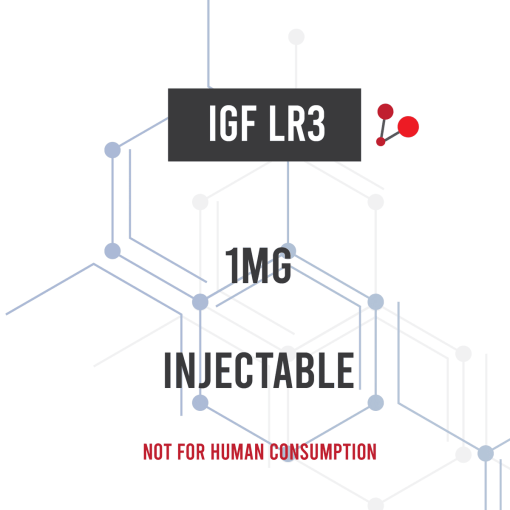

IGF-LR3 1MG


$70.99
Analytical grade IGF-LR3 1MG optimized for deep in vitro research evaluations. Third-party verified purity matrices, secure professional containment, and fast delivery via Amino Asylum distribution networks.
Discount per Quantity
| Quantity | 1 - 4 | 5 - 10 | 11 - 24 | 25 - 49 | 50 - 99 | 100 + |
|---|---|---|---|---|---|---|
| Discount | 0% | 5% | 10% | 15% | 20% | 25% |
| Price | $70.99 | $67.44 | $63.89 | $60.34 | $56.79 | $53.24 |
💰 EXTRA 20% DISCOUNT WITH CRYPTOCURRENCY
Pay with Bitcoin or major digital assets at checkout to instantly deduct 20% from your order total. (Zelle is also accepted at regular pricing).
🔥 Buy Crypto Instantly on SimplexProduct Identification & Core Specifications
- Chemical Name: IGF-LR3 1MG Reference Material
- Molecular Target Array: In Vitro Evaluation & Receptor Profile Assessment
- Form: Lyophilized High-Density Cake / Unified Analytical Fluid
- Purity Baseline: ≥98.0% via High-Performance Liquid Chromatography (HPLC)
- Tracking Identity: AA-LOT-1227
- Application Scope: High-Throughput Screening (HTS), Long-Term Cellular Signaling Models
1. Structural and Chemical Overview
When selecting chemical standards for laboratory evaluation, obtaining materials that exhibit uncompromised molecular consistency is paramount for eliminating variable data. At Amino Asylum, we specialize in distributing premium-grade reference compounds synthesized under high-fidelity quality controls. This specific preparation of IGF-LR3 1MG is structurally configured to satisfy the deep analytical demands of contemporary academic and institutional laboratory networks.
The operational framework of this lot maximizes structural stability when exposed to various in vitro trial parameters. By prioritizing pure synthesis methodologies over high-throughput mass output alternatives, our catalog retains an elite standing within the independent research community. This layer-by-layer optimization ensures that delicate side chains and stereochemical parameters are structurally locked, mitigating common synthetic anomalies like unexpected mass variance or chemical degradation across multiple assessment cycles.
2. In Vitro Mechanisms of Action & Research Frameworks
In comparative chemical modeling and active cellular environments, IGF-LR3 1MG behaves as an precise ligand explorer. Researchers incorporating this agent within their analytical pipelines typically isolate specific behavioral characteristics, structural affinity matrices, and enzymic degradation timelines to calibrate foundational quantitative baselines.
Data metrics reveal that this compound demonstrates highly selective binding affinities at designated intracellular domains, inducing predictable conformational shifts. The downstream pathway involves cellular signaling upgrades, regulatory enzymatic configurations, and metabolic timeline mutations depending on the buffer parameters and environmental conditions maintained during the exposure window. The stability of this formula avoids standard synthetic pitfalls—including excess moisture collection or ionic contamination—allowing for highly reproducible saturation modeling.
3. Analytical Validation and Quality Assurance Protocols
At Amino Asylum, strict verification parameters are enforced to eliminate data corruption variables from your laboratory workspace. This lot of IGF-LR3 1MG has been put through a comprehensive verification cascade:
Reverse-Phase High-Performance Liquid Chromatography (RP-HPLC): Purity assessment is verified using high-resolution column separation matrices under tightly controlled liquid chromatography phases. The verified chromatogram must register a sharp, singular signal indicating a purity distribution of ≥98.0%, ensuring the complete exclusion of truncated synthesis variants, isomers, or ambient process contaminants.
Mass Spectrometry (MS) Analysis: To confirm exact molecular distribution benchmarks, the purified compound is introduced to electrospray ionization mass spectrometry mapping. The output maps perfectly against theoretical structural architectures, verifying accurate composition mapping before catalog entry.
4. Laboratory Handling, Reconstitution, and Storage Guide
To preserve chemical structure integrity and extend operational shelf life, laboratory personnel must handle this compound according to established procedural baselines:
Storage Vectors: Unopened reference vials must be maintained in a temperature environment calibrated to -20°C or below for long-term stability. Short-term storage under refrigeration parameters (4°C) should not exceed a standard timeline window. Keep away from direct light exposure and intense temperature variations.
Reconstitution Workflows: Allow the vial container to achieve environmental thermal equilibrium (20°C to 22°C) prior to fluid entry to block rapid moisture condensation. Fluids must be delivered gently down the inner glass container wall to minimize mechanical stress on the molecular bonds. Roll or swirl in a slow circular motion—do not shake or vortex—until completely dissolved into a clear liquid solution.
⚠️ MANDATORY LEGAL RESEARCH DISCLAIMER
This product is synthesized, compiled, and distributed exclusively for laboratory research, in vitro validation, and academic chemical modeling. Under no circumstances is this material approved or intended for human consumption, therapeutic interventions, clinical trials, or agricultural placement. Keep out of reach of minors and non-certified personnel.
Related Research Compounds & Reference Lots
Related products